Transforming Global Supply and Value Chains: Looking Back on Our 2-day Project Conference
On 28 and 29 September 2026, our annual conference “Transforming Global Supply and Value Chains: Europe’s Role between Resilience, Sustainability and Competitiveness” took place at the HWR Berlin Campus Schöneberg, organised in cooperation with the Arbeitskreis Europäische Integration. Over two days, academics at every career stage and guests from industry and practice explored a shared question: How can European production networks stay competitive, become more sustainable and prove resilient? The programme combined research from our own project with contributions from external speakers. The full programme is available here.
Day 1: Transformation, sustainable supply chains and geopolitics
The first panel addressed growth regimes in transition and the role of Europe. Project members presented analyses of demand-led growth and macroeconomic policy regimes in seven countries, as well as two frameworks: one explaining uneven development trajectories in contemporary capitalism, and one on the external anchors of growth models in the semi-periphery. A keynote then put forward ideas for a new theoretical approach: recent developments indicate that capitalism may be moving from a liberal to an organised phase, in which firms are increasingly subject to national development and security goals. For global value chains, this puts state priorities at the centre, but does not necessarily mean stronger human rights or environmental standards. In a poster session, early-career researchers had the opportunity to present their work and engage with participants. The second panel asked whether sustainability and resilience are pathways to viable supply chains, and the third examined European perspectives on geopolitical competition and the transformation of global value chains. A second keynote concluded the day, showing how firms respond to policy uncertainty by diversifying suppliers and countries rather than systematically reshoring, and how concentrated supplier structures amplify risks in interconnected supply chains.
Day 2: Regulation, competitiveness and human rights
The second day focused on the regulation of global supply chains. The first panel examined reactions to European regulation: how due diligence shapes firms’ imports, how pharmaceutical supply chains adapt to the European pharmaceutical strategy, and whether European regulation has a “Brussels Effect”. The keynote that followed focused on the negotiation process in Geneva towards a binding international instrument on business and human rights. On the panel afterwards, representatives from practice and academia discussed, from different perspectives, whether Europe can balance competitiveness, responsibility and resilience in regulating global supply chains. The final panel belonged largely to early-career researchers presenting their work.
Exhibitions
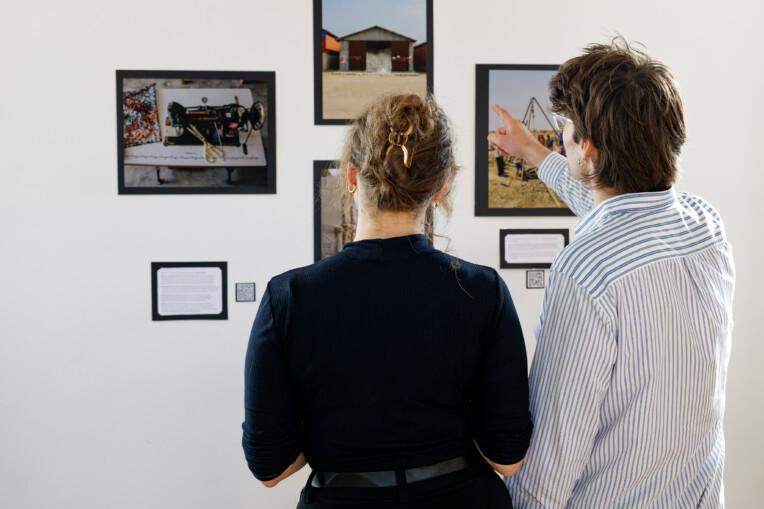
The conference was accompanied by two exhibitions: a photography exhibition by Reversed Magazine, which examines fair and sustainable supply chains through journalism, and “Common Ground: From Extraction to Electrification” by Paul Mengeling, a visual exploration of the past and future of mineral extraction in four European regions in the context of the lithium rush.